Pulse
Management & integration system
An internal platform that unifies a company’s sales and operations — and the integration architecture that lets four disconnected tools work as one.
- Role
- Full‑stack developer
- Year
- 2025–26
- Type
- Internal platform · Sales & operations
- Access
- Private — internal system
- TypeScript
- Next.js
- Node.js
- Prisma

Context
One company, four tools — and no single place where they met.
Pulse was built for a company whose commercial operation ran on separate systems. Meta Ads brought in the leads, conversations happened on WhatsApp, deals were closed on calls and payments went through Herospark.
Each of those tools held part of every customer’s story. None of them held all of it, and none of them talked to the others.
Meta Ads
TrafficWhatsApp
ConversationsCalls
SalesHerospark
Payments
Problem
The answers existed — just never in the same place.
Which ad brought this sale?
Has this customer actually paid?
Who takes over the account once the deal is closed?
Questions like these meant opening several tools and matching records by hand. The core technical challenge was to orchestrate disconnected external systems — traffic, calls, WhatsApp, payments — into a single, coherent and scalable architecture.
What I built
One platform for the whole commercial cycle, from the first ad to the renewal.
Pulse organizes the operation into eight modules over the same data: sales, call analysis, marketing, contacts, client management, post‑sales and the platform’s own management — plus a TV Mode that puts the day’s numbers on the office screens.
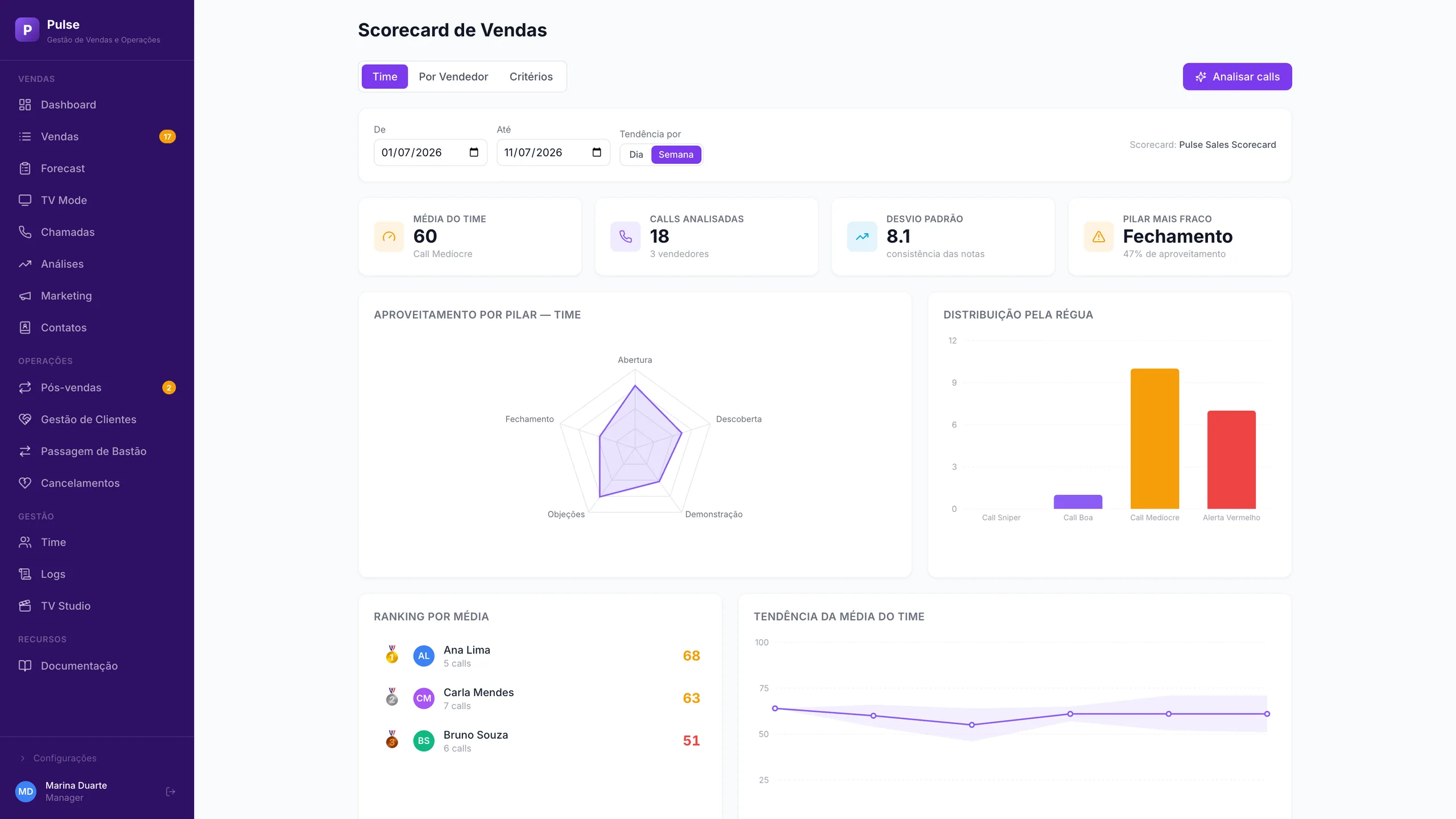
AI sales scorecard
Calls graded pillar by pillar — opening to closing — exposing the team's weakest skill.
Swipe · tap to zoom
Fig. 03 — Real product screens, grouped by module · all data shown is fictitious demo data
In the product
Financial dashboards
Revenue, targets and KPIs unified in real time.
TV Mode
Live sales gamification for big screens.
Payment gateway
End‑to‑end integration with Herospark.
Kanban CRM + Health Score
Customer pipeline with account health computed.
Marketing analytics
Tracking from Meta Ads to the WhatsApp conversation.
Churn management
Public and private retention dashboards.
Forecast + Handoff
Forecasting with automated handoff to CS.
Architecture & decisions
Every system talks to Pulse — never to each other.
- Meta Ads · Traffic
- Calls
- Payments · Herospark
Pulse
Orchestration layer · single API
- Dashboards · TV Mode
- CRM · Health Score
- Marketing · Attribution
- Forecast · Handoff → CS
- Prisma data model
- Background jobs
- Audit log
- Role-based access
Decisions
One door per system
Meta Ads, WhatsApp, calls and Herospark each connect to Pulse at a single point, and every module reads from the same API. A new integration is wired in once — and every screen can use it.
Match records instead of chasing them
A new sale finds the lead’s SDR by phone number and the ad that brought them in. A forecast row flips to Paid on its own when a Herospark purchase arrives with the same e‑mail or phone.
Compute signals ahead of time
Background jobs precompute each account’s journey signals and health score. Journey milestones tick themselves as the integrations report back, instead of waiting for someone to update them.
Access and accountability by design
Managers, closers, SDRs and CS each see what their role allows, and an immutable audit log records who created, edited or canceled what.
Result
Sales and operations now work from the same data.
From the ad that brought a lead to the renewal of the account, every step lives in one system. Payment confirmation, the handoff from sales to CS and the journey milestones happen on their own — and the team follows the day’s pace live on the office TVs.
Pulse in numbers
- External systems, one platform
- 4 → 1
- Modules over the same data
- 8
- Team roles, each with its own access
- 4
My role
From the first integration to the last screen.
Full‑stack development — from the integration architecture to the back‑end (Node.js · Prisma) and the dashboards’ interface.
Integration architecture
How each external system connects to Pulse, and how its data reaches every module.
Back‑end & data
The data model with Prisma, the business rules, the background jobs and the audit trail.
Interfaces
The dashboards, the boards and the TV Mode.
Built with
- Node.js
- TypeScript
- Next.js
- Prisma